
What Are Life Skills
And Why Adults Still Need Them
Here’s the uncomfortable truth nobody says out loud: most of us made it to adulthood without anyone actually teaching us how to do adulthood. Not really. Nobody sat us down and walked us through how to manage our time without burning out, how to regulate our emotions when everything feels like too much, how to set a boundary without a week of guilt afterward, or how to build a daily routine that survives a Tuesday. We were just… expected to know. And somehow, not knowing became a thing we quietly blame ourselves for.
What Life Skills Actually Are (And What They’re Not)
Life skills are not the same as professional skills or academic knowledge. Knowing how to code, write a report, or pass a certification exam — those are hard skills. Life skills are the everyday competencies that help you function, make decisions, manage yourself, and build relationships in the real world. They are the internal operating system running underneath everything else you do.
And no — life skills are not just for teenagers in a middle school health class. They are for anyone who has ever stared at their to-do list feeling paralyzed, snapped at someone they love because they were stretched too thin, or said yes when every cell in their body meant no. That is most of us. Here are some of the most important life skills examples worth building:
- Emotional regulation and self-awareness
- Time management and prioritization
- Boundary-setting and assertive communication
- Decision-making under pressure
- Financial literacy and budgeting basics
- Stress management and nervous system regulation
- Self-advocacy in personal and professional settings
- Building and maintaining routines that actually stick
- Conflict resolution without shutting down or blowing up
- Asking for help — and accepting it gracefully
This is your life skills list — not an exhaustive one, but a grounded, honest starting point for adults who want to feel steadier in their everyday lives.
The Core Categories of Adult Life Skills
Essential life skills don’t exist in isolation. They tend to cluster into a few key areas of daily life. Understanding the categories helps you figure out where to start — instead of trying to fix everything at once and fixing nothing.
Emotional Regulation and Self-Awareness
This is the foundation. Everything else gets harder when you’re emotionally dysregulated — when you’re running on fumes, reacting instead of responding, and feeling like your emotions are happening to you rather than through you. Emotional regulation doesn’t mean being calm all the time. It means building enough self-awareness to notice what you’re feeling before it runs the show.
Self-awareness is where this starts: being able to name what you’re experiencing, trace it back to a trigger, and choose how you respond instead of defaulting to autopilot. For many adults, this is genuinely new territory — and it’s some of the most important inner work you can do.
Practices that build this skill include journaling, somatic check-ins, therapy, mindfulness, and honest self-reflection. None of these have to be elaborate. Even two minutes of writing down what you’re feeling before bed is more self-awareness than most people practice in a week.
Time Management and Daily Structure
Time management gets a bad reputation because most of the advice out there treats humans like productivity machines. Wake up at 5 a.m. Time-block every hour. Optimize your morning. But here’s what that advice ignores: you are a person with a body, a mood, a complicated life, and days that go sideways. Real time management isn’t about control — it’s about structure that bends without breaking.
Daily structure gives your brain a framework so it doesn’t have to reinvent the day from scratch every morning. Even a loose anchor — a consistent wake time, a small morning ritual, a written list of your top three priorities — can dramatically reduce decision fatigue and the anxiety of feeling like you’re always behind.
The goal isn’t a perfect schedule. The goal is a rhythm you can return to when things fall apart, because things will fall apart. Building a flexible structure is one of the most underrated adult life skills there is.
Communication and Boundary-Setting
Communication is not just about what you say — it’s about what you’re willing to say, and what you allow others to say to you. Boundary-setting sits at the heart of this. And if nobody modeled healthy boundaries for you growing up, you’re not behind — you’re just working with the tools you were given.
Boundaries are not walls. They’re not punishments. They’re information: about what you need, what you can give, and where your capacity ends. Communicating them clearly — without over-explaining, apologizing seven times, or waiting until you’re so resentful you explode — is a skill that can absolutely be learned.
This also includes the quieter side of communication: listening without formulating your rebuttal, asking for what you actually need, and being honest in low-stakes conversations so you don’t bottle things up until they become high-stakes problems.
Practical Wellness Habits
Wellness, as a concept, has been hijacked by an industry that wants you to buy things. But at its most basic, practical wellness is just: are you sleeping? Are you eating in a way that doesn’t make you feel worse? Are you moving your body in some form, even a little? Are you giving yourself any kind of recovery time between demands?
These aren’t luxury behaviors. They’re maintenance. And when you’re a busy parent, an overwhelmed professional, or a small business owner wearing seventeen hats, they’re often the first things to go — which is exactly when you need them most.
Practical wellness habits don’t have to be expensive or time-consuming. A ten-minute walk. A glass of water before coffee. Eight hours of sleep treated as a non-negotiable, not a reward. Tiny, consistent inputs add up to a fundamentally different baseline over time.
Why So Many Adults Struggle With Life Skills (It’s Not Your Fault)
Let’s be direct about something: the reason you weren’t taught these skills is not a personal failure. Schools were designed to produce workers, not whole humans. The curriculum has long prioritized academic achievement and career readiness over things like emotional intelligence, self-regulation, and financial literacy. If you graduated high school without knowing how to manage your emotions under pressure or set a boundary with your boss, that’s a gap in the system — not proof that something is wrong with you.
Then there’s hustle culture, which has spent decades telling us that rest is laziness, that busy equals valuable, and that if you’re struggling to keep up, you just need to try harder. That narrative is not only exhausting — it actively punishes the self-reflection and slowdown that building life skills requires. You can’t develop self-awareness when you’re running on empty and told that slowing down is weakness.
And for parents — especially those who are also working, running businesses, or caregiving for others — the bandwidth simply isn’t there. When you’re managing everyone else’s needs all day, your own development gets pushed to the bottom of a list that never gets that far. None of this is a character flaw. It’s math. You’re doing a lot. You’re allowed to be at the beginning of something even if you’re already deep into your adult years.
How to Build Life Skills as a Busy Adult
The most important thing to understand about building life skills as an adult is this: you don’t have to overhaul your life. You have to take the next tiny, doable step. That’s it. Tiny steps, repeated over time, are the mechanism of actual change — not the dramatic reset, not the perfect routine, not the ideal conditions that never arrive.
Here’s a realistic starting framework:
- Pick one area, not five. Look at the categories above — emotional regulation, time management, communication, or wellness — and choose the one that’s costing you the most right now. Start there.
- Shrink the action until it feels almost too easy. Want to journal? Start with one sentence a day. Want to build a morning routine? Start with one consistent anchor, not eight. The bar should feel low enough that you can clear it on your worst day.
- Make the skill visible. Write it down. Put it somewhere you’ll see it. Track it simply — even a checkmark on a sticky note. What gets tracked gets done, at least more often.
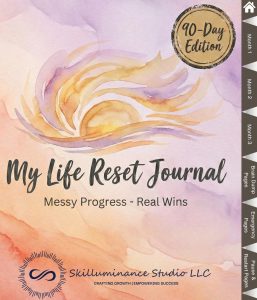
- Use tools that meet you where you are. You don’t need a complicated system. A guided journal, a worksheet, a simple daily planner — anything that reduces the cognitive load of figuring it out from scratch. My My Life Reset Journal was built specifically for this: a 90-day guided journal that walks you through daily structure, self-reflection, and habit-building in small, manageable prompts.
- Expect imperfection and plan for it. You will miss days. Life will interrupt. The skill you’re building is resilience, not perfection. Getting back on track quickly — without a spiral of self-criticism — is itself a life skill worth practicing.
Life Skills Tools and Resources
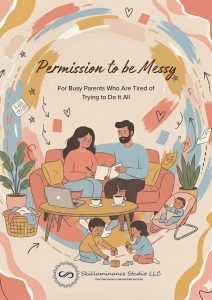
One of the biggest barriers to building life skills as a busy adult isn’t motivation — it’s the friction of not knowing where to start or what to use. That’s why Skilluminance offers a range of tools designed for people who don’t have hours to spare and don’t need another overwhelming self-improvement system. If you’re just getting started, our free life skills resources are a genuinely useful first stop. The Permission to Be Messy ebook is a good entry point if you’re carrying a lot of shame around not having everything figured out — it’s short, honest, and written for real humans. The Mini Life Reset Journal gives you a simple daily structure without demanding too much time or energy to set up.
When you’re ready to go deeper, our digital planners and life skills tools offer guided support across multiple areas — from productivity and habit-building to self-care and boundary-setting. And if you’re someone who wants more personal, one-on-one support, our life skills coaching program works with you directly to identify what’s getting in the way and build practical strategies around your actual life — not a hypothetical organized one. Whatever stage you’re at, there’s a starting point that meets you there.
Frequently Asked Questions
What are the most important life skills for adults?
The most important life skills for adults tend to be the ones that have the widest ripple effects: emotional regulation, time management, and communication. When these three are even partially in place, nearly every other area of life gets a little easier. Emotional regulation helps you respond instead of react — which improves your relationships, your decision-making, and your stress levels. Time management reduces the constant feeling of being behind. And communication, especially boundary-setting, protects your energy and your relationships simultaneously. If you had to pick one to start with, ask yourself: which of these is costing me the most right now?
Can you learn life skills as an adult?
Absolutely — and this is well-supported by research on neuroplasticity, which shows that the brain retains the ability to form new habits and patterns throughout life. Learning life skills as an adult is actually different in one important way from learning them as a child: you have more context. You know what isn’t working. You can feel the gap between where you are and where you want to be, which gives you real motivation. You may also have more autonomy to practice these skills in your daily life than you did growing up. It’s never too late, and starting later doesn’t mean you’ll progress more slowly — often it means the opposite.
What life skills are not taught in school?
The list is long, which is part of why so many adults feel underprepared. Most schools don’t teach emotional regulation or how to process difficult feelings constructively. They don’t teach how to set boundaries or have hard conversations without conflict spiraling. Financial literacy is largely absent — most adults learn (often the hard way) how credit, debt, budgeting, and savings actually work. Practical wellness — sleep hygiene, stress management, basic nutrition — is rarely addressed in any meaningful way. And perhaps most critically, schools don’t teach self-awareness: the ability to notice your own patterns, understand your triggers, and make intentional choices instead of reactive ones.
How long does it take to build a new life skill?
The honest answer is: it depends on the skill, your starting point, and how consistently you practice. The popular idea that it takes 21 days to form a habit has been largely debunked — research from University College London suggests it’s closer to 66 days on average, with significant variation. But the more useful frame isn’t about time at all — it’s about repetition and recovery. Every time you practice a skill and every time you get back to it after dropping it, you’re building it. There’s no deadline. The goal is integration into your daily life, not a finish line.
What is the best tool for building life skills as a busy adult?
The best tool is the one you’ll actually use — which means it needs to be low-friction, easy to access, and designed for your real life rather than an idealized version of it. For many people, a guided digital journal is the most practical starting point: it structures your thinking without requiring you to figure out what to write or where to begin. The My Life Reset Journal was built with exactly this in mind — daily prompts for self-reflection and habit-building, designed to take minutes rather than hours. If you want to explore before committing, start with our free life skills resources and see what resonates.
Related Posts


Practical tools for the overwhelmed and over-committed!
Sign up for Free Resources
These are free resources and a credit card is NOT required. By providing this contact information you give Skilluminance express written authorization to contact you via automated email. That’s how we deliver the resources – make sure your provide the correct email and add to the safe sender’s list. We won’t spam – promise.