
Burnout Recovery
A Realistic Guide for Busy Parents and Professionals
If you’re reading this while running on empty — checking your phone in a parking lot, scrolling during the two quiet minutes before the kids wake up, or just staring at the screen because you’ve lost the thread of what you were even trying to do — first, I want you to know something: you’re not broken. You didn’t fail at life. You burned out. And this guide won’t add a single item to your to-do list. If anything, it’s going to help you start taking things off.
What Burnout Actually Feels Like (Beyond Just Being Tired)
Burnout gets dismissed a lot. People confuse it with ordinary tiredness, and when you tell someone you’re burned out, you often get “sleep more” or “take a weekend off” as the prescription. But burnout isn’t just a bad week. A good night’s sleep doesn’t fix it. A long weekend doesn’t fix it. You can sleep nine hours and wake up feeling like you haven’t slept at all — because burnout runs deeper than fatigue. It’s a state of chronic depletion that affects your body, your emotions, and your ability to think clearly.
The clinical picture includes three core dimensions: exhaustion, cynicism, and a reduced sense of personal accomplishment. But what it feels like on a Tuesday morning is harder to name. It feels like you’ve become a stranger to yourself — going through the motions of your own life, with caring about things taking more effort than you have. Here are some of the signs that what you’re experiencing might be burnout, not just a rough patch:
- You wake up already exhausted, no matter how much you slept
- Tasks that used to feel easy now feel overwhelming or pointless
- You’ve become emotionally flat — not sad exactly, just numb
- Small inconveniences trigger disproportionate frustration or tears
- You’ve started dreading things you used to look forward to
- You can’t concentrate — you re-read the same paragraph four times and retain nothing
- You feel guilty about resting, but also resentful that you never get to
- You’ve stopped doing things just for enjoyment — there’s no mental energy left for “fun”
- Your body is giving you signals: headaches, tight chest, disrupted sleep, getting sick more often
- You feel like you’re failing everyone, even when you’re technically keeping up
If several of those landed for you, take that seriously — not in a “fix it immediately” way, but in an honest, compassionate “this is real and it deserves attention” way.
Why Burnout Hits Parents and Professionals Hardest
Burnout doesn’t discriminate, but it does compound. For parents who are also professionals — or for anyone holding multiple demanding roles simultaneously — the math is brutal. You’re not just doing one high-stakes job. You’re doing three or four. Employee. Parent. Partner. Adult human who somehow needs to eat vegetables and schedule dentist appointments and also have a personality. Each role carries its own set of expectations, and none of them pause while you’re showing up for the others.
There’s also the “always on” culture that’s soaked into modern work and parenting alike. Notifications that don’t stop. School emails after dinner. Work messages on weekends that are “just a quick question.” A news cycle that’s genuinely relentless. The expectation that you are always available — to your employer, your kids, your inbox — leaves no space for the nervous system to actually recover. Rest has become a performance. Even vacations become logistics projects. And when you’re on, you’re supposed to be fully on; nobody asks how you are and actually waits for an honest answer.
Then there’s emotional labor — the invisible, exhausting work of managing other people’s feelings while also managing your own. Parents absorb their children’s big emotions all day. Professionals absorb clients, coworkers, and ambient institutional stress. Small business owners carry both, plus their livelihood riding on every decision. This isn’t weakness. It’s structural. Performing and suppressing emotions for others depletes real psychological resources. There’s only so much to give before the well runs dry.
The Burnout Recovery Myth You Need to Drop
Here’s what most burnout advice looks like: take a vacation, do a digital detox, practice self-care. And look — there’s nothing wrong with any of those things. But they position burnout recovery as a destination you reach after a dramatic reset. For most burned-out parents and professionals, that reset isn’t possible. You can’t take a month off. You can’t quit your job. You can’t pause your kids. If your recovery plan requires a life overhaul, it’s not a plan — it’s a fantasy, and fantasies tend to make you feel worse when they stay out of reach.
At Skilluminance, we believe in something different: messy progress over perfection. Burnout recovery doesn’t look like a clean before-and-after transformation. It looks like making tiny sustainable choices inside the life you actually have. It’s less about addition — more sleep, more exercise, more journaling — and more about subtraction, protection, and the radical act of doing a little less, deliberately. Small, consistent shifts build something real. A dramatic overhaul usually collapses under its own weight. If you’re ready to explore digital planners and self-care tools designed around this philosophy, we’ve got options built for exactly where you are right now.
A Realistic Burnout Recovery Plan (Step by Step)
This isn’t a 30-day program. There’s no challenge. No streak to maintain. These are five steps you can move through at whatever pace your life actually allows — and you can return to them whenever you need to.
Step 1 — Stop Adding, Start Subtracting
The instinct when you’re burned out is often to add more: more structure, more habits, more self-improvement. Resist this. The first real step in burnout recovery is to look at your current commitments, obligations, and mental load — and start looking for things to remove, delegate, pause, or simply say no to. Not everything is removable. But there is almost always something. A meeting that doesn’t need you. A volunteer obligation you said yes to out of guilt. A standard you’re holding yourself to that nobody else is tracking. Start there.
This step isn’t about quitting everything. It’s about creating the first sliver of breathing room. You cannot recover inside a completely full container. Something has to give, and you get to choose what — rather than waiting until your body chooses for you.
Step 2 — Stabilize Your Basic Rhythms First
Before you optimize anything, focus on the basics: sleep, food, and one short window of not-being-needed each day. Sleep is not a luxury — it’s how your nervous system processes stress and repairs itself. Eating real food at regular intervals keeps your blood sugar from amplifying every difficult emotion. And even fifteen minutes alone — in your car, outside, wherever — counts as recovery time if you protect it. This step will feel too small. That’s fine. Small and sustainable beats ambitious and abandoned every time.
Step 3 — Rebuild Emotional Awareness
Burnout often includes a kind of emotional numbness — you stop noticing how you feel until it becomes a crisis. Rebuilding emotional awareness means creating small, low-stakes moments to check in with yourself. Not therapy sessions (though those are genuinely valuable). Just honest, brief questions: What do I actually need right now? What am I carrying that I haven’t named? Where am I pretending to be okay when I’m not?
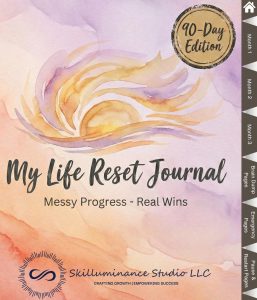
This is where My Life Reset Journal was built to help. It includes gentle daily prompts designed not to overwhelm, but to help you hear yourself again — without needing to have it all figured out. Even a few honest sentences a day starts to move the needle.
Step 4 — Reintroduce Structure Without Rigidity
As you stabilize, structure becomes your friend — but only the flexible kind. Rigid schedules tend to collapse the moment life interrupts, and when they collapse, people who are already burned out blame themselves. What works better is loose scaffolding: a rough morning routine that doesn’t require perfection, a few non-negotiable anchors in your week, and a way to track what actually happened rather than what was supposed to happen.
The Life Reset Journal is also well-suited for this step — it helps you build structure gradually, in a format that allows for imperfect weeks and honest reflection rather than performance. Our broader life skills for adults resources cover this territory as well, including how to build systems that work with your actual energy levels rather than against them.
Step 5 — Protect Your Recovery
Recovery doesn’t happen once and stay. It needs guardrails — which means recognizing the patterns that created burnout and actively protecting against them: communicating limits more directly, auditing your commitments regularly, questioning the stories you tell yourself about how much you “should” be able to handle. If life skills coaching is something you’re open to, working with someone trained in sustainable structure can make a meaningful difference — not because you can’t do this alone, but because it’s genuinely easier with support.
What Burnout Recovery Actually Looks Like Day-to-Day
Real burnout recovery is not a montage. Most of the time, it looks like waking up and doing a thirty-second check-in instead of immediately grabbing your phone. A midday pause — even just a few slow breaths in the car — counts as recovery time if you treat it that way. Some days the check-in reveals something useful. Some days it just reminds you that you’re still here, still trying, and that counts.
On the hard days, the win might simply be getting through it without catastrophizing. It might be choosing not to answer that email after 8 p.m. Recovery is not linear. There will be weeks that feel like setbacks. That’s not failure — that’s what recovery from anything looks like. The question isn’t “am I better yet?” It’s “am I treating myself more honestly than I was before?” That’s the direction. That’s enough.
Free Burnout Recovery Resources from Skilluminance
We’ve put together a collection of free tools specifically for people who are too depleted to start with something big. The Permission to Be Messy ebook is the perfect starting point if your burnout is driven by perfectionism, over-functioning, or the belief that you have to earn rest. It’s honest, it’s short, and it doesn’t pretend recovery is cute. The Mini Life Reset Journal is a low-commitment daily structure tool — just a few prompts per day — designed for people who want to rebuild some semblance of intention without adding a 45-minute morning routine to an already impossible schedule.
Both are free because we believe you shouldn’t have to pay to feel less alone in this. Head over to our free burnout recovery resources page to download them. No upsell at the end, no long email sequence. Just the tools, yours to use.
Frequently Asked Questions
How long does burnout recovery take?
There’s no universal timeline. Mild-to-moderate burnout can show meaningful improvement over several weeks of intentional recovery; severe burnout that’s been building for years may take months. The more important frame: recovery isn’t a finish line, it’s an ongoing practice. You’ll feel incremental shifts before you feel transformed. Small improvements compound.
Can you recover from burnout while still working?
Yes — and for most people, this is the only realistic option. It requires honest assessment of what’s driving the burnout and at least some capacity to change it: a conversation with a manager, a renegotiated workload, recovery practices built around your actual schedule rather than an ideal one. It’s harder than recovering with unlimited time off. It’s also what most people have to work with, and it is possible.
What is the first step to recovering from burnout?
Acknowledge that what you’re experiencing is burnout — not weakness, not a character flaw. Naming it accurately changes how you respond to it. After that, the most actionable move is subtraction: look at your current load and identify one thing you can remove, reduce, or stop doing. Not everything needs to change at once. One thing is a start.
Is burnout the same as depression?
They share many symptoms — low energy, loss of interest, difficulty concentrating, emotional flatness — which makes them hard to distinguish. The key difference: burnout is situationally driven, tied to specific chronic stressors. Depression tends to be more pervasive and may have biological components. That said, unaddressed burnout can develop into clinical depression, and the two can co-exist. If you’re unsure which you’re dealing with, talk to a mental health professional who can help you find the right level of support.
What tools help with burnout recovery?
The tools that help most are low-effort, honest, and consistent rather than elaborate or aspirational. Structured journaling prompts help rebuild emotional awareness better than blank-page journaling. Light physical movement — not a training plan, just gently moving your body — supports nervous system regulation. Simple daily anchors restore a sense of agency without requiring perfection. Our digital planners and self-care tools are designed for exactly this kind of slow, sustainable rebuild — not for people who have it all together, but for people who are trying to get back there.
If you’re reading this while running on empty — checking your phone in a parking lot, scrolling during the two quiet minutes before the kids wake up, or just staring at the screen because you’ve lost the thread of what you were even trying to do — first, I want you to know something: you’re not broken. You didn’t fail at life. You burned out. And this guide won’t add a single item to your to-do list. If anything, it’s going to help you start taking things off.
Related Posts



Practical tools for the overwhelmed and over-committed!
Sign up for Free Resources
These are free resources and a credit card is NOT required. By providing this contact information you give Skilluminance express written authorization to contact you via automated email. That’s how we deliver the resources – make sure your provide the correct email and add to the safe sender’s list. We won’t spam – promise.