
How to Build a Morning Routine That Actually Sticks
(Even on Chaotic Days)
Let’s be honest about something upfront: most morning routine advice is written for people who have no kids, no commute, and suspiciously cooperative alarm clocks. The advice assumes you have an hour of uninterrupted time before anyone else in the house wakes up, a body that springs out of bed without protest, and a life that holds still long enough for you to light a candle and write in a gratitude journal. If that’s you — wonderful. If that is emphatically not you — you’re in the right place.
A morning routine doesn’t have to be perfect. It doesn’t have to be long. It doesn’t have to look like anyone else’s. It just has to be yours — small enough to survive a sick kid, flexible enough to bend around an early meeting, and honest enough to account for the fact that your brain needs twenty minutes before it can form complete sentences. This guide is about building exactly that.
Why Most Morning Routines Fail
The most common reason morning routines fall apart isn’t laziness or lack of discipline. It’s that they’re built for an ideal version of your day — the version where nothing goes sideways, everyone cooperates, and you somehow have ninety minutes to yourself before 7am. Routines designed for your best-case morning collapse completely the moment reality shows up, which it will, regularly and without warning.
All-or-nothing thinking makes this worse. If your routine has eight steps and you miss step three, it can feel like the whole thing is ruined — so you abandon it entirely instead of just skipping one part and continuing. This is a cognitive trap, not a character flaw. But it’s one worth naming, because it’s the mechanism that kills most good intentions before they have time to become habits.
The third problem is that most morning routine advice implicitly assumes unlimited time. Even “short” routines in popular productivity content often clock in at forty-five minutes to an hour. For a parent getting kids ready for school, a professional with a 7:30am meeting, or anyone who simply didn’t sleep enough, that timeline is not a plan — it’s a fantasy.
What a Realistic Morning Routine Actually Looks Like
Here’s the reframe: a morning routine is not a performance. It’s a signal — a small, consistent cue to your nervous system that the day is beginning, that you exist before the demands start, and that you get to have some agency in how you move into the morning. Even ten minutes of intentional structure counts. Even five. The goal is not to optimize your morning. The goal is to not feel ambushed by it.
A bare-minimum morning routine might include just a few anchors:
- One consistent wake time (even on hard days)
- Water before anything else
- Two to five minutes of a simple grounding practice — a short journal prompt, a few deep breaths, or just sitting quietly before picking up your phone
- A glance at your top three priorities for the day
- One small act of self-care — movement, a cup of tea made without multitasking, five minutes outside
That’s it. That can be your whole routine. It can happen in ten minutes. It is enough.
How to Build Your Morning Routine in 4 Steps
Step 1 — Start With What You Already Do
You already have a morning routine — it’s just unconscious. Before you build a new one, notice what you actually do every morning. When does your alarm go off? What’s the first thing you reach for? What happens between waking up and leaving the house or starting work? Mapping your current reality is the starting point, not a shameful confession. You can’t redesign something you haven’t looked at honestly.
From there, you’re not replacing your morning from scratch — you’re inserting small intentional moments into a structure that already exists. That’s far more sustainable than trying to rewire your entire morning at once.
Step 2 — Choose One Anchor Habit
An anchor habit is the one non-negotiable thing that signals morning has started in a way you control. It could be making your bed. It could be a five-minute walk. It could be a specific song you always play while getting ready. It doesn’t matter what it is — what matters is that it’s consistent, it’s yours, and it happens before the day’s demands fully take over.
Anchor habits work because they’re small enough to be nearly frictionless, which means they happen even on the hardest days. And on the hardest days, one small act of intention is often the difference between a day you move through and a day that moves through you.
Step 3 — Design for Your Worst-Case Morning, Not Your Best
This is the step most people skip, and it’s the most important one. When you’re designing your routine, don’t plan for the morning when everything goes smoothly. Plan for the morning when someone can’t find their shoes, you slept badly, and you have a call in forty minutes. What can you do in that morning that still counts? That stripped-down version is your actual routine — the one that will survive contact with real life.
Your ideal-conditions version is a bonus. Something to enjoy when things go well. But the bare-minimum version is the foundation, and it’s the one worth protecting.
Step 4 — Use a Simple Prompt to Ground Yourself
One of the most effective things you can add to a morning routine is a single grounding prompt — one question or sentence that brings you briefly into your own experience before the day’s external demands take over. Something like: what do I need this morning? What’s one thing I want to feel today? What am I carrying that I can set down?
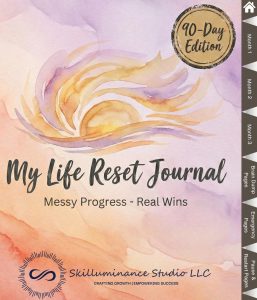
You don’t need a full journaling practice to benefit from this. Even thirty seconds of honest self-check-in creates a thread of self-awareness you can return to throughout the day. The My Life Reset Journal was built specifically for this — it includes a brief morning prompt designed for people who don’t have time to journal but want more than just surviving until lunch. Five minutes. One question. A completely different way to start the day.
Morning Routine Tips for Specific Situations
Morning Routine Tips for Busy Parents
When you’re managing kids’ mornings alongside your own, the concept of “your” morning time often feels laughable. The key shift here is to stop looking for a block of uninterrupted time and start looking for small pockets — two minutes in the bathroom before anyone else wakes up, a single grounding breath before you open the bedroom door, a short journal prompt while the kids eat breakfast. Your routine doesn’t have to be separate from the chaos. It just has to exist somewhere within it.
Morning Routine Tips for Overwhelmed Professionals
When your mornings are immediately overtaken by emails, Slack messages, and calendar anxiety, the most important thing you can do is create a brief buffer between waking and working. Even fifteen minutes of not-yet-professional time — before you check your phone, before you open a laptop — gives your nervous system a chance to arrive in the day as a person rather than a function. Protect that window fiercely. It’s not wasted time. It’s the thing that makes the rest of the day more sustainable.
Morning Routine Tips When You Have 10 Minutes or Less
If ten minutes is genuinely all you have, here’s your routine: drink water, take three slow breaths, write down your one most important task for the day. That’s it. Three things, five minutes, done. It won’t transform your life overnight. But done consistently, it will give you a small but real sense of agency over your mornings — and that compounds into something meaningful over time.
The Biggest Morning Routine Mistakes (And How to Avoid Them)
- Building a routine for your best-case morning. Design for your worst day instead — that version will actually survive.
- Starting with too many steps. One anchor habit is enough to begin. Add more only after the first one is solid.
- Treating a missed day as a failed routine. Missing a day is normal. The routine fails only when you stop returning to it. Come back tomorrow.
- Comparing your routine to someone else’s. A 4am cold plunge is not a universal good. Build for your body, your season of life, your actual constraints.
- Skipping the night before. How your morning feels is often decided the night before — what time you went to bed, whether you set out what you need, whether you have a rough sense of the next day. A brief evening wind-down is the foundation your morning stands on.
- Waiting until conditions are perfect to start. They won’t be. The imperfect routine you start today is more valuable than the perfect one you keep planning.
Free Morning Routine Tools from Skilluminance
If you want support building a morning routine without the pressure of figuring it all out yourself, Skilluminance has a few tools worth starting with. The Mini Life Reset Journal — available as a free download — includes morning prompts that take under five minutes and were specifically designed for people who want daily structure but don’t have the bandwidth for a full journaling practice. It’s a low-commitment starting point that gives you something concrete to try without requiring you to overhaul your morning from scratch. You can grab it and the other free morning routine tools at the link.
When you’re ready for more, the full My Life Reset Journal gives you 90 days of morning, midday, and evening structure — a complete daily rhythm built for busy, imperfect humans. It works alongside our broader range of printable planners and daily structure tools, all designed to reduce the friction of showing up for yourself on the days when showing up feels like the hardest thing. And if you want more personalized support figuring out what kind of structure works for your specific life, our life skills coaching program can help you build that — alongside guidance on burnout recovery and life skills for adults that make the whole structure stick.
Frequently Asked Questions
How long should a morning routine be?
As long as it needs to be and no longer. There is no ideal length — some people thrive with a two-hour morning ritual, others genuinely function better with a ten-minute version. The right length is the one that fits into your actual life without requiring you to sacrifice sleep, create stress, or build resentment toward the routine itself. Start shorter than you think you need to. You can always add.
What is the most important part of a morning routine?
Consistency over complexity. The most important part of any morning routine is that it actually happens — not that it has the right components or runs for the right amount of time. One simple, repeatable anchor habit done daily will do more for your mornings than an elaborate twelve-step system done three times a week. Start with the smallest possible version of a routine and protect it.
How do I start a morning routine when I have no time?
Start with one minute. Literally. One minute of intentional breathing, one minute of stillness before you pick up your phone, one minute of writing down what you need today. Something that small is almost impossible to talk yourself out of, even on the most chaotic morning. Once the one-minute habit is stable — once it’s happening consistently without effort — then you can expand it. But the one minute is not a placeholder for the “real” routine. It is the real routine, at the beginning.
What should a morning routine include for mental health?
For mental health specifically, the most valuable morning elements are ones that regulate your nervous system before the day’s demands activate it. This includes: a consistent wake time (irregularity disrupts mood more than most people realize), some form of movement even if it’s brief, avoiding your phone for at least the first ten to fifteen minutes, and a short moment of self-check-in — noticing how you actually feel before you start managing how everything else needs you to feel. These four things, done imperfectly and inconsistently, are still meaningful. Done regularly, they can substantially shift your baseline.
How do I stick to a morning routine when life gets chaotic?
Design a crisis version. Before life gets chaotic, decide: if everything falls apart tomorrow morning, what is the absolute minimum version of my routine that I can still do? Write it down. Make it small — two or three things at most. When chaos hits, you don’t abandon the routine. You execute the crisis version instead. This keeps the habit alive through disruption without requiring you to pretend the disruption isn’t happening. Over time, returning to the routine after chaos becomes the habit — which is arguably the most valuable habit of all.
Related Posts



Practical tools for the overwhelmed and over-committed!
Sign up for Free Resources
These are free resources and a credit card is NOT required. By providing this contact information you give Skilluminance express written authorization to contact you via automated email. That’s how we deliver the resources – make sure your provide the correct email and add to the safe sender’s list. We won’t spam – promise.